1. Olfactory Fatigue in Newly Constructed Spaces
Following the completion and handover of new interior spaces, airborne concentrations of volatile chemical compounds typically reach their peak. However, occupants often perceive a “noticeable decrease in chemical odor” shortly after occupying the space.
From a physiological perspective, this phenomenon is known as Olfactory Fatigue (sensory adaptation). The human olfactory system rapidly desensitizes to continuous background chemical exposure. Consequently, the absence of a perceptible odor does not indicate that gaseous contaminant concentrations have dropped to safe biological thresholds.
2. The Science of Off-Gassing Kinetics: Formaldehyde & TVOCs
In modern building design, engineered wood products, surface finishes, carpets, and structural adhesives are industry-standard materials. The release of volatile compounds from these materials follows established chemical-physical mechanisms:
- Formaldehyde (HCHO): Commonly found in synthetic resins (such as Urea-Formaldehyde). Even with materials certified to low-emission standards (E1 or E0), the continuous release of free HCHO persists. The natural off-gassing half-life of Formaldehyde can range from 3 to 10 years, depending on material load and environmental parameters.
- Total Volatile Organic Compounds (TVOCs): Including Benzene, Toluene, and Xylene emitted from solvent-based coatings and insulation materials. These gaseous compounds directly impact Indoor Environmental Quality (IEQ) and occupant respiratory health.
3. Environmental Drivers: The Role of Temperature and Humidity
The off-gassing kinetics of Formaldehyde and TVOCs are strongly governed by thermal and hygrometric conditions within the building envelope:
- Thermal Desorption Effect: Elevated indoor temperatures increase the vapor pressure of volatile compounds. Environmental chamber studies demonstrate that an increase in ambient temperature from 20°C to 30°C can accelerate Formaldehyde emission rates from composite wood by 1.5 to 2.5 times.
- Hygrometric Hydrolysis Effect: High relative humidity (RH) supplies moisture molecules that promote the hydrolysis of polymer bonds in adhesives, exacerbating the release of free Formaldehyde gas.
- The Sealed Enclosure Challenge: During hot or humid seasons, sealing building envelopes to operate cooling systems without adequate fresh air exchange leads to peak accumulation of gaseous contaminants due to the lack of volumetric dilution.
4. Integrated IEQ Engineering Approach by PVHC Indoor Air Solution
To manage indoor air quality in new facilities through quantitative, data-driven methodology, PVHC Indoor Air Solution provides comprehensive Indoor Environmental Quality (IEQ) engineering:
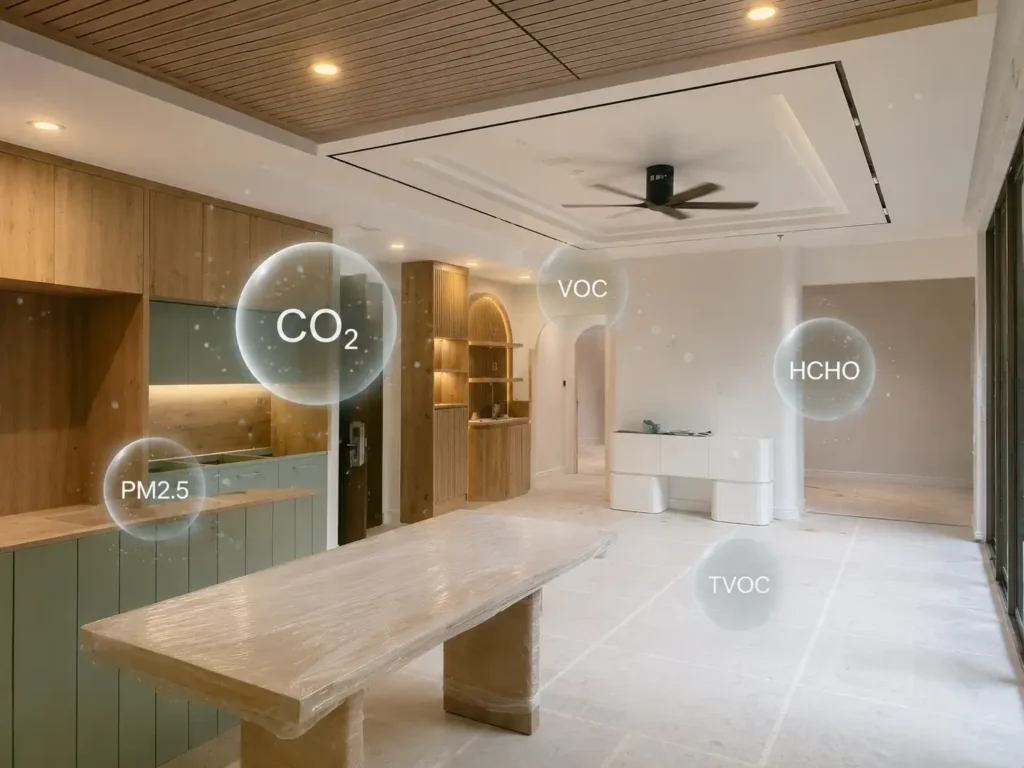
- Quantitative Environmental Profiling: Utilizing calibrated sensors to measure real-time HCHO, TVOC, and CO2 concentrations, establishing precise baseline data across functional zones.
- Positive Pressure Contaminant Flushing: Calculating optimal fresh air exchange rates aligned with ASHRAE 62.1 standards to continuously dilute and flush accumulated HCHO and TVOCs out of the building.
- Synchronized Microclimate Control: Integrating precise temperature and humidity management to suppress environmental triggers for chemical off-gassing, ensuring a safe indoor climate.
Scientific References
- World Health Organization (WHO). WHO guidelines for indoor air quality: selected pollutants (Formaldehyde, TVOCs).
- US Environmental Protection Agency (EPA). An Introduction to Indoor Air Quality (IAQ): Volatile Organic Compounds (VOCs).
- ASHRAE Standard 62.1. Ventilation for Acceptable Indoor Air Quality in Commercial and Residential Buildings.