Clean drinking water is not simply about choosing a water purifier.
The right drinking water solution depends on where your water comes from, what is already known about its quality, what you need to remove, and how the treated water will be used.
For one home, a simple carbon filtration system may be enough. For another, reverse osmosis may be the more appropriate choice. In some cases, additional treatment or monitoring may also be required.
The right approach is to understand the water first — then choose the technology.
What Should You Consider Before Choosing a Drinking Water System?
Before looking at brands, technologies or specifications, start with four questions:
1. Where does your water come from?
The source of your water matters.
Municipal water, groundwater, rainwater and water from private wells can have very different characteristics. Even when water is treated at the source, its quality can change as it travels through storage tanks, pipes and plumbing systems before reaching your tap.
Understanding the source provides the first indication of what may need to be treated.
2. What is actually in the water?
Not every water problem can be identified by taste, smell or appearance.
Water may contain substances that are not immediately noticeable, while an unpleasant taste or odour does not necessarily mean the water is unsafe.
Depending on the source and local conditions, concerns may include:
- Sediment and suspended particles
- Chlorine and compounds affecting taste and odour
- Hardness and dissolved minerals
- Heavy metals
- Microbiological contamination
- Nitrate and other dissolved contaminants
- Other site-specific or source-specific pollutants
This is why choosing a filtration system solely from the water’s appearance can be misleading.
Water quality assessment should come before technology selection whenever possible.
Different Technologies Solve Different Problems
There is no single filtration technology that is ideal for every home.
Carbon Filtration
Activated carbon is commonly used to reduce chlorine, unpleasant tastes and odours, and certain organic compounds.
It can be a practical solution when the main objective is improving the taste and overall drinking experience of already treated water.
Ultrafiltration (UF)
UF uses a membrane with very small pores to remove particles and many microorganisms while retaining most dissolved minerals.
It can be suitable where microbiological and particulate control is important without significantly changing the mineral content of the water.
Reverse Osmosis (RO)
RO uses a semi-permeable membrane to reduce a broad range of dissolved substances, including many salts, minerals and other contaminants.
It is particularly useful when the source water contains elevated levels of dissolved contaminants that conventional filtration cannot adequately address.
However, RO is not automatically the best choice for every home. It requires appropriate system design, maintenance and consideration of water recovery and the characteristics of the treated water.
UV Treatment
Ultraviolet treatment can be used as a disinfection stage to inactivate microorganisms.
UV does not remove dissolved chemicals, minerals or particles, so it is normally considered as part of a treatment system rather than a complete filtration solution by itself.
Point-of-Use or Whole-House Treatment?
Another important decision is where the water should be treated.
Point-of-Use
Point-of-use systems treat water at a specific location, such as a kitchen drinking-water tap.
They are often appropriate when the primary objective is producing high-quality water for drinking and cooking without treating the entire home’s water supply.
Whole-House Treatment
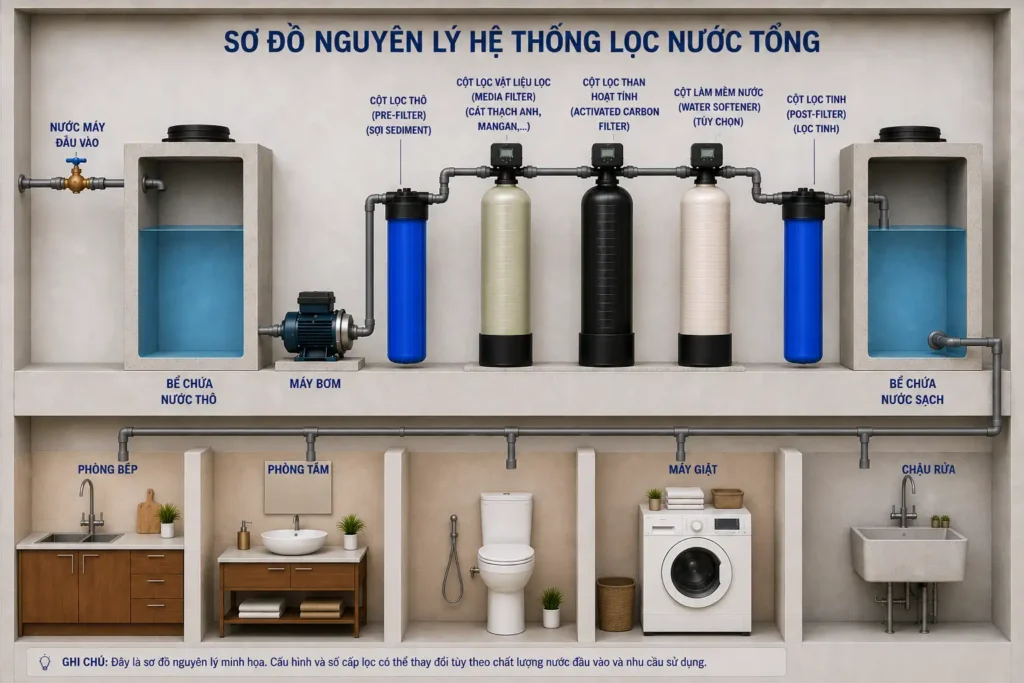
Whole-house systems treat water before it reaches multiple points of use throughout the home.
They are more appropriate when the concern extends beyond drinking water — for example, when water quality affects showers, bathrooms, appliances or the entire domestic water system.
Drinking water treatment and whole-house water treatment are different applications.
They should not automatically be treated as the same problem.
What About Minerals?
Removing contaminants is only one part of water treatment.
Some technologies, particularly RO, also reduce dissolved minerals. Whether this is desirable depends on the source water, treatment objectives and the overall system design.
For this reason, a good drinking-water system should be evaluated as a complete solution rather than by looking at the removal rate of a single contaminant.
The goal is not simply to remove as much as possible.
The goal is to produce water that is appropriate for its intended use.
Don’t Forget the System After Installation
Even a well-designed water treatment system needs proper maintenance.
Filters have finite service lives. Membranes can foul. Storage tanks and internal components can require cleaning. Disinfection systems may need periodic inspection.
The quality of the water at the tap therefore depends not only on the treatment technology, but also on:
- Correct system sizing
- Installation quality
- Filter and membrane replacement
- Hygiene and maintenance
- Water storage conditions
- Monitoring and periodic assessment
A technically sophisticated system that is poorly maintained may not deliver the expected result.
So, Which Drinking Water System Is Right for Your Home?
There is no universal answer.
The right solution depends on:
Water source → Water quality → Treatment objective → Household usage → System design → Maintenance
For example:
| Situation | Possible approach |
|---|---|
| Mainly concerned about taste and chlorine | Carbon filtration |
| Need particulate and microbiological reduction | UF or combined filtration |
| High dissolved contaminants | RO or other appropriate treatment |
| Microbiological concern | UV or membrane-based treatment |
| Water quality concerns throughout the house | Whole-house treatment |
| Uncertain water quality | Assess the water before selecting technology |
These are starting points, not automatic recommendations. Actual water quality and system requirements should determine the final design.
Start With the Water, Not the Filter
A drinking-water system should solve a water-quality problem — not simply add another appliance to the kitchen.
Before choosing a technology, understand:
What is the source?
What is in the water?
What needs to be reduced or removed?
How will the water be used?
How will the system be maintained and monitored?
Once these questions are answered, choosing the appropriate treatment technology becomes much clearer.
PVHC Approach
At PVHC, we look at drinking water as part of a wider Indoor Environmental Engineering approach.
Rather than starting with a specific product, we start with the water, the application and the performance requirement — then identify the appropriate combination of treatment, equipment and monitoring.
Understand your water. Choose the right solution.