1. The Afternoon Slump: It Is Not Just Lack of Sleep
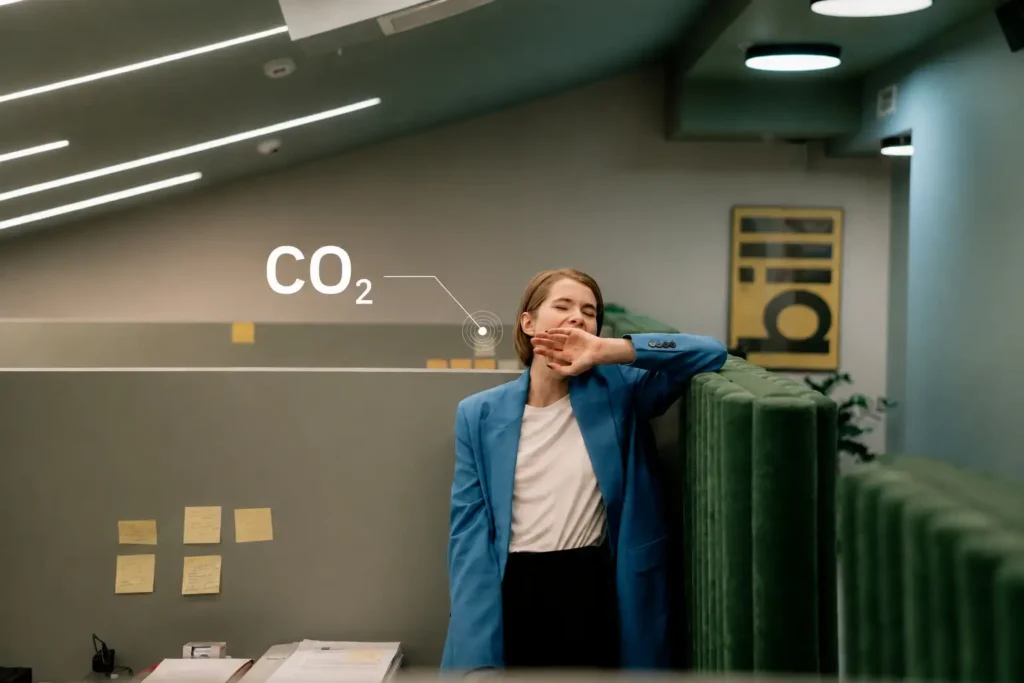
It is a common scenario in modern offices: around 2:00 PM to 4:00 PM, employees start experiencing brain fog, headaches, fatigue, and difficulty concentrating. While often blamed on heavy lunches or lack of sleep, building environmental science reveals a primary culprit: Severe air quality degradation due to inadequate fresh air ventilation.
When spaces operate on tight thermal recirculation to cut energy costs, enclosed offices rapidly turn into stagnant pollution traps.
2. Scientific Evidence: High CO2, TVOCs, and Sick Building Syndrome (SBS)
World Health Organization (WHO) and U.S. EPA define Sick Building Syndrome (SBS) as a condition where building occupants experience acute health and comfort effects linked to time spent in a building, with poor Indoor Air Quality (IAQ) as the leading cause.
- The CO2 Trap & Cognitive Decline: Human respiration continuously generates CO2. In sealed offices, CO2 levels quickly spike from outdoor baseline (~415 ppm) to 1,200 – 2,000+ ppm. Research led by the Harvard T.H. Chan School of Public Health (The CogFX Study) demonstrated that high CO2 levels directly impair cognitive function, strategic thinking, and crisis response by up to 50%.
- Chemical Off-Gassing (TVOCs): Office equipment (printers, copiers), synthetic carpets, engineered wood furniture, and cleaning agents continuously emit Total Volatile Organic Compounds (TVOCs). Without proper dilution, these compounds cause eye, nose, and throat irritation.
- The Economic Equation for Investors & Facility Operators: Human capital accounts for nearly 90% of an organization’s operating budget. Shutting off fresh air dampers to save minor cooling energy silently destroys high-value human productivity — a hidden financial loss far exceeding utility savings.
3. Integrated IEQ Engineering Approach by PVHC Indoor Air Solution
Addressing Sick Building Syndrome requires sophisticated Building Environmental Engineering that aligns human performance with operational efficiency. PVHC Indoor Air Solution delivers integrated IEQ strategies:
- Demand-Controlled Energy Recovery Ventilation (DC-ERV): Real-time CO2 and TVOC sensor data dynamically govern ventilation rates. Fresh air is pre-conditioned for enthalpy (temperature and humidity) and multi-stage purified before delivery, maintaining CO2 strictly below 800 ppm at optimal energy performance.
- Gas-Phase & Ultrafine Airborne Contaminant Control: Integrating advanced MERV/HEPA filtration alongside gas-phase chemical media into central supply pathways to continuously neutralize TVOCs, odors, and fine particulate matter.
- Airflow Dynamics & Uniform Microclimate Distribution: Computational airflow planning eliminates stagnation zones in high-density office layouts, ensuring uniform fresh air delivery and thermal equilibrium across every workstation.
Scientific References
- Harvard T.H. Chan School of Public Health (CogFX Study). Associations of Cognitive Function Scores with Carbon Dioxide, Ventilation, and Volatile Organic Compound Exposures in Office Workers.
- U.S. Environmental Protection Agency (US EPA). Sick Building Syndrome (SBS) & Indoor Air Quality in Commercial Buildings.
- ASHRAE Standard 62.1. Ventilation for Acceptable Indoor Air Quality in Commercial Buildings.