We often think of drinking water as something simple: water should be clear, clean and safe to drink.
But water quality is more complicated than appearance alone.
Depending on its source, environment and distribution system, drinking water can contain microorganisms, naturally occurring minerals, metals or other chemical substances. Some may have an immediate effect on health, while others become a concern mainly after long-term exposure.
Understanding these potential risks does not mean assuming that every water supply is unsafe. It means understanding that different water sources can have different risks — and that water quality should be considered in the context of the people who use it.
Not Everything in Water Can Be Seen
Some water-quality problems are easy to notice.
- Cloudy water
- Unusual colour
- Unpleasant taste
- Strong or unusual odour
- Visible particles or sediment
These characteristics can be useful warning signs, but they do not tell the whole story.
Some substances that may be relevant to health cannot be detected reliably by looking at, smelling or tasting the water.
This is one reason why the visual appearance of water should not be treated as a complete measure of its safety.
Water can look clean without providing enough information to determine whether it is safe.
Microorganisms: A Different Kind of Water Risk
One of the most important categories of drinking-water hazards is microbiological contamination.
Bacteria, viruses and parasites can enter water when sanitation and source protection are inadequate or when water becomes contaminated during handling, storage or distribution.
Unlike many chemical contaminants, microbial contamination can sometimes cause illness relatively quickly.
Symptoms associated with contaminated water can include gastrointestinal illness such as diarrhoea and vomiting. The severity of illness can vary depending on the microorganism and the individual exposed.
This is particularly important for people who may be more vulnerable to infectious diseases.
Lead: A Concern That Can Come From the Plumbing
Lead is an important example of why water quality cannot always be understood simply by looking at the original water source.
Lead can enter drinking water through materials and components that come into contact with water, particularly where older plumbing or unsuitable components are present.
Lead exposure is particularly concerning for children because of its potential effects on the developing nervous system.
For this reason, the quality of water at the source does not necessarily tell us everything about the quality of water at the tap.
The path from source to point of use matters.
Arsenic: A Long-Term Exposure Concern
Arsenic can occur naturally in groundwater because of local geological conditions.
This makes arsenic particularly relevant in areas where groundwater is an important source of drinking water.
The concern with arsenic is generally associated with long-term exposure rather than a single glass of water.
Long-term exposure to inorganic arsenic has been associated with a range of health effects, including changes to the skin and an increased risk of certain cancers.
The important point is that the presence of arsenic is highly dependent on the source and local conditions. It should therefore be assessed rather than assumed.
Nitrate: Why the Source of Water Matters
Nitrate can enter water from agricultural activities, fertilisers, animal waste and wastewater.
Groundwater in agricultural areas can therefore have different risks from water drawn from a protected source.
Nitrate is particularly important for infants because high levels in drinking water can interfere with the ability of blood to carry oxygen.
This is an example of why water-quality assessment should consider not only the contaminant itself, but also who is consuming the water.
Disinfection Is Important — But It Is Not the Whole Story
Disinfection is an essential part of protecting drinking water from microorganisms.
Chlorine and other disinfectants are widely used to control microbial contamination in water supplies.
However, disinfectants can also react with naturally occurring organic matter in water and form disinfection by-products.
This does not mean that disinfected water is unsafe. Rather, drinking-water safety requires a balance between controlling microorganisms and managing other potential risks.
Water treatment is therefore not simply about removing as much as possible.
It is about managing risks appropriately.
What About Minerals in Drinking Water?
Not every substance found in water is automatically a contaminant.
Water naturally contains minerals, and their concentrations can vary significantly between different sources.
Calcium and magnesium, for example, are common naturally occurring minerals in drinking water.
The presence of minerals should therefore not automatically be interpreted as a health problem.
The more useful question is whether a particular substance is present at a concentration that is relevant to the intended use and applicable water-quality requirements.
Why Long-Term Exposure Matters
When people think about contaminated water, they often imagine an obvious event: someone drinks contaminated water and becomes sick.
That is only one possible scenario.
Some water-quality concerns are associated with repeated exposure over months or years rather than an immediate reaction.
This makes drinking-water safety different from many other everyday health decisions.
The relevant question is not always:
“Will this water make me sick today?”
Sometimes the more important question is:
“What am I being exposed to repeatedly over a long period of time?”
Who May Be More Vulnerable?
The potential health significance of a contaminant can vary between individuals.
Some groups may be more vulnerable to particular water-related hazards, including:
- Infants and young children
- Pregnant women
- Older adults
- People with weakened immune systems
- People with certain underlying health conditions
This does not mean that these groups will necessarily experience harm from ordinary drinking water. It means that water-quality decisions may need to consider the people who are actually using the water.
The Journey From Source to Tap Matters
Drinking water does not exist only at the source.
It travels through a system before reaching the person who drinks it.
A simplified way to understand this journey is:
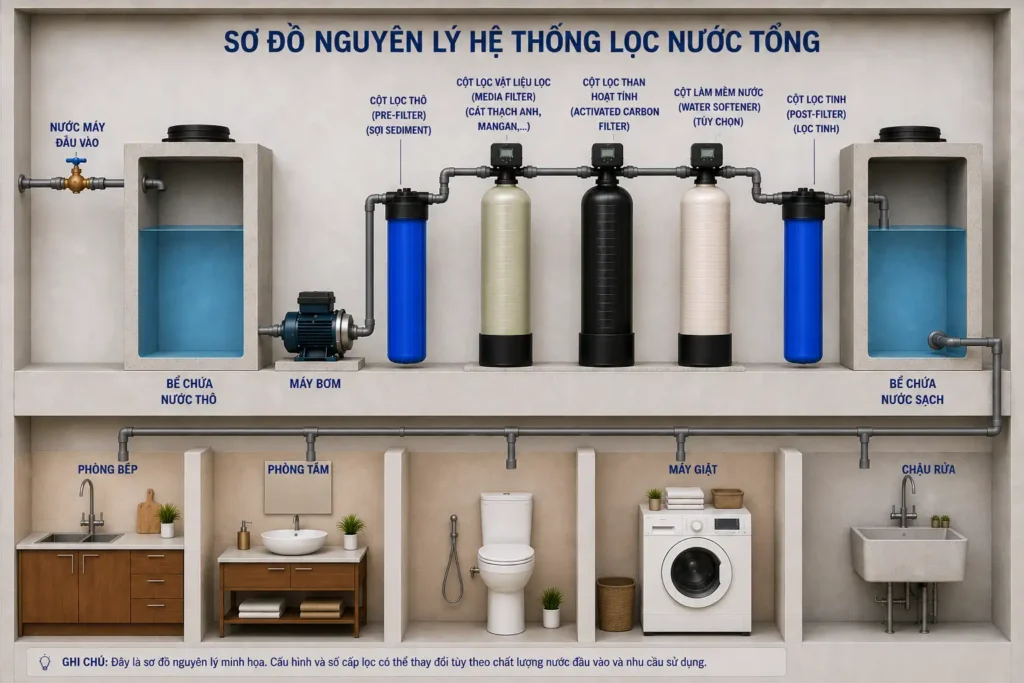
Source → Treatment → Storage → Distribution → Tap → Consumer
Each stage can influence water quality.
Natural conditions may affect the source. Treatment controls certain risks. Storage and distribution can influence the water further. Finally, plumbing and fixtures inside a building can also affect the water before it reaches the tap.
This is why water quality is best understood as a system rather than as a single point.
Does This Mean Tap Water Is Unsafe?
No.
The presence of potential contaminants in drinking water does not mean that a particular water supply is unsafe.
Water quality varies enormously between locations and sources, and regulated water supplies are subject to treatment, monitoring and quality requirements.
The important principle is to avoid making conclusions without understanding the actual source and relevant water-quality information.
At the same time, relying only on appearance or assumptions about the water source may not provide enough information when there is a specific concern.
When Is It Worth Looking More Closely at Your Water?
A closer look at water quality may be appropriate when:
- The water source has changed.
- There is a persistent change in taste, colour or odour.
- The property relies on groundwater or a private well.
- The building has older plumbing.
- There is a known local water-quality issue.
- Water is stored for extended periods before use.
- The household includes people who may be particularly vulnerable to certain contaminants.
- You simply do not have reliable information about the quality of the water being consumed.
The appropriate response depends on the specific situation. Sometimes the answer is simply to obtain reliable information about the water source. In other cases, testing may be appropriate.
Water Safety Starts With Understanding Exposure
One of the most useful ways to think about drinking-water safety is to separate three questions:
- What is present in the water?
- How much exposure is occurring?
- Who is being exposed?
The first question is about water quality.
The second is about concentration, frequency and duration of exposure.
The third is about the characteristics and vulnerability of the people using the water.
Together, these questions provide a much more meaningful picture than simply asking whether water is “clean” or “dirty”.
A Better Way to Think About Drinking Water
Safe drinking water is not defined by whether the water looks perfectly clear or tastes pleasant.
It is about managing the risks associated with the source, the treatment process, the distribution system and the people who ultimately consume the water.
For homeowners, the practical lesson is simple:
Know your water source. Understand the potential risks. Pay attention to changes. Test when there is a reasonable reason to do so.
Water is something we consume every day. Understanding what is in it is therefore not about creating unnecessary fear. It is about making better-informed decisions about an essential part of everyday life.
Conclusion
Drinking water can contain many naturally occurring or introduced substances, but not everything present in water represents a health risk.
The significance depends on the substance, its concentration, the duration of exposure, the source of the water and the people consuming it.
That is why the most useful question is not simply whether water is “clean”.
It is:
“What is in the water, where did it come from, and does it matter for the people using it?”
Understanding those questions is the first step toward making better decisions about drinking-water quality and health.