
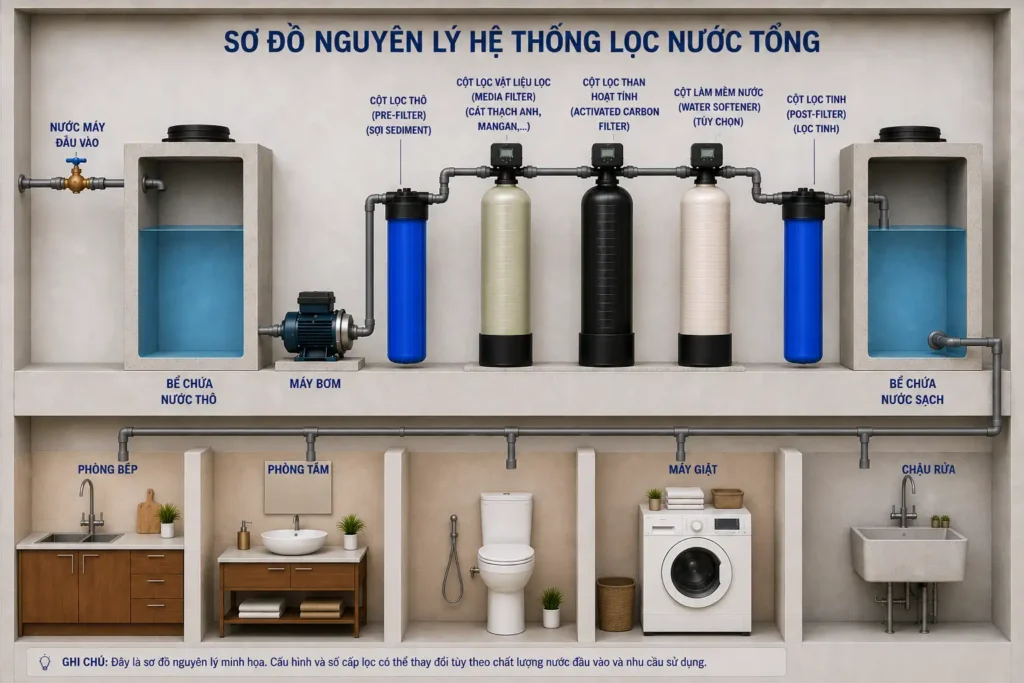
A whole-house water filtration system can sound like a simple solution: treat the water once as it enters the house, then use treated water throughout the home.
But whether you actually need one is a different question.
Not every household has the same water problem. Some homes may mainly need sediment removal. Others may have concerns about chlorine taste and odour, hardness, scale, iron, or other water-quality issues. In some cases, the right solution may be a combination of different treatment technologies rather than a single filter.
A whole-house system also does not automatically mean that every tap produces drinking water of the same quality as a dedicated drinking-water system.
The better approach is to start with the water itself:
What is the problem → what needs to be treated → what technology is appropriate → what system makes sense for the home?
What Is a Whole-House Water Filtration System?
A whole-house water treatment system, also known as a point-of-entry (POE) system, is installed where water enters the home so that treated water can be distributed throughout the building.
This is different from a point-of-use (POU) system, which treats water at a specific location, such as a kitchen tap.
The advantage of whole-house treatment is that it can address water used throughout the home rather than only water from one tap.
Depending on the incoming water quality and treatment objectives, a system may include:
- Sediment filtration
- Activated carbon treatment
- Water softening
- Iron or manganese treatment
- Disinfection
- Other specialised treatment technologies
There is therefore no single whole-house configuration that is appropriate for every home.
The treatment system should be selected according to the characteristics of the water and the actual household requirements.
Why Do Homeowners Consider Whole-House Water Treatment?
Sediment and visible particles
Some homes experience water containing suspended particles that may appear as:
- Cloudy water
- Brown or yellowish water
- Sediment in fixtures
- Deposits inside plumbing
- Particles collected in tap aerators
A sediment filter may be appropriate when suspended solids are the main concern.
However, visible particles do not tell you everything about water quality. The source and cause should still be understood before selecting a treatment system.
Chlorine taste or odour
Some households dislike the taste or smell associated with treated municipal water.
Activated carbon is commonly used to reduce certain chemicals and improve taste and odour.
If the objective is to improve water taste and odour throughout the home, whole-house carbon treatment may be appropriate depending on the water quality and system design.
Hard water and scale
Hard water contains elevated levels of minerals, particularly calcium and magnesium.
The problem may become noticeable through:
- Scale on shower screens
- Deposits around taps
- Scale inside water-using appliances
- Soap and detergent performance
- White deposits on bathroom surfaces
An important distinction is that hardness is not simply a filtration problem.
Water softeners use ion-exchange technology to reduce hardness. They are therefore a different treatment category from a conventional sediment or carbon filter.
If scale is the actual problem, installing a standard whole-house filter may not solve it.
Does Every House Need a Whole-House Water Filter?
No.
Installing a large treatment system without first understanding the water problem can add unnecessary cost, maintenance and complexity.
A household may not need whole-house treatment if:
- The incoming water is already suitable for the intended household uses.
- The main concern is only drinking-water taste.
- The problem occurs at only one point of use.
- A simple point-of-use system can address the actual requirement.
- There is no significant water-quality problem that requires treatment throughout the home.
In other situations, whole-house treatment may make much more sense.
For example, if the objective is to improve the quality of water used for showering, washing, laundry and other household applications, treating only the kitchen tap does not address the whole problem.
The right question is therefore not:
“What is the best whole-house water filter?”
It is:
“What does the water need to be treated for, and where does that treatment need to happen?”
7 Signs Your Home May Need Water Treatment
There is no universal checklist that can replace water-quality assessment, but certain observations may justify further investigation.
1. Persistent sediment or discolouration
If water repeatedly contains visible particles or unusual colour, the source and cause should be investigated.
2. Strong or unusual taste or odour
Persistent chlorine, earthy, metallic or other unusual characteristics may indicate that the water should be assessed.
3. Significant scale formation
Frequent deposits on taps, shower surfaces or appliances may indicate hardness or another mineral-related issue.
4. Problems with water-using appliances
Scale and sediment can affect appliances that regularly use water.
5. Different water quality at different locations
If water quality varies between parts of the house, the cause may involve the building’s plumbing rather than only the incoming water supply.
6. A private water source
Homes using groundwater, wells or other private sources may require a different assessment approach from homes connected to a municipal supply.
7. You are building or renovating
A new-build or major renovation provides an opportunity to consider water treatment before the plumbing system is completed.
This can be easier than trying to retrofit a treatment system later.
What Should You Check Before Choosing a System?
This is one of the most important steps.
Before selecting equipment, establish what is actually present in the water.
Depending on the source and the concern, relevant parameters may include:
- Turbidity
- pH
- Hardness
- Iron
- Manganese
- Chlorine or disinfectant residual
- Total dissolved solids
- Microbiological parameters
- Other contaminants associated with the local water source
The exact testing programme should depend on the water source and the problem being investigated.
A treatment system should then be designed around the results.
Different technologies remove different contaminants.
For example, a water softener is designed primarily to reduce hardness. It should not be treated as a general-purpose solution for microorganisms or every chemical contaminant.
This is why choosing equipment before understanding the water can easily result in the wrong system.
Whole-House Treatment vs. Drinking-Water Filtration
One of the most common misunderstandings is assuming that whole-house water treatment and drinking-water filtration are the same thing.
They are not.
A whole-house system treats water entering the building and can be designed for household applications such as bathing, washing and general water use.
A dedicated drinking-water system focuses on water at a specific point of use.
For example, a home might have:
Whole-house treatment
→ Sediment control
→ Carbon treatment
→ Hardness management
→ Other application-specific treatment
and separately:
Kitchen drinking-water treatment
→ More targeted treatment for drinking and food preparation
The appropriate configuration depends on the incoming water quality and the household’s requirements.
Installing a whole-house system therefore does not automatically eliminate the need for a dedicated drinking-water system.
What Technologies Can Be Used?
A whole-house system may combine several treatment stages.
Sediment filtration
Used primarily to reduce suspended particles and help protect downstream plumbing and equipment.
Activated carbon
Often used to reduce certain chemicals and improve taste and odour.
Water softening
Ion-exchange softeners are designed to reduce water hardness caused mainly by calcium and magnesium.
UV disinfection
UV systems can be used for microbial control in appropriately designed systems. Their application depends on the incoming water quality and system conditions.
Reverse osmosis
Reverse osmosis is a more intensive treatment process and is generally better suited to targeted applications rather than automatically treating the entire household water supply.
The important point is that more filtration does not automatically mean better water.
The treatment should match the actual problem.
What About Maintenance?
A whole-house system is not a “fit and forget” installation.
Maintenance requirements depend on the technologies used, but may include:
- Filter replacement
- Media replacement or regeneration
- System cleaning
- Water-quality monitoring
- Checking pressure and flow
- Servicing valves and controls
- Maintaining disinfection equipment where applicable
The ongoing cost can therefore be just as important as the initial equipment price.
When comparing systems, consider:
Initial cost + installation + consumables + maintenance + water use + expected service life
rather than looking only at the equipment price.
When Does a Whole-House System Make Sense?
A whole-house water treatment system becomes more compelling when there is a clear household-wide problem that cannot be adequately addressed at a single point of use.
It may be worth considering when:
- Water-quality concerns affect multiple outlets.
- Hardness or scale is causing widespread problems.
- Sediment is entering the household plumbing.
- Taste or odour concerns extend beyond drinking water.
- A private water source requires treatment.
- A new home is being designed and the system can be integrated from the beginning.
- The household wants a coordinated water-treatment strategy rather than several unrelated devices.
But the system should still be designed around the actual water quality.
When Is a Professional Water Assessment Useful?
Professional assessment is particularly useful when the problem is unclear.
For example, if a homeowner says:
“The water looks fine, but the taps develop scale very quickly.”
The answer should not automatically be:
“Install a whole-house filter.”
The first question should be:
What is causing the scale?
Similarly, if the water has an unusual smell, the appropriate response is not necessarily to install a carbon filter immediately.
The source, water quality and potential causes should be considered first.
A proper assessment can help determine:
- What is in the water?
- What problem actually needs to be solved?
- Which water uses require treatment?
- Which treatment technology is appropriate?
- Where should treatment be installed?
- What maintenance will be required?
That process usually produces a better result than selecting equipment first and trying to make it fit the problem afterwards.
PVHC Engineering Insight
Whole-house water treatment is not a product category that can be selected independently of the water.
The right system depends on:
Water source → Water quality → Household requirements → Treatment objective → System design
A sediment filter, carbon system, water softener, UV system and reverse osmosis system perform different functions.
They should not be treated as interchangeable products.
For homeowners, the most important step is therefore not finding the largest or most expensive filter.
It is understanding what needs to be treated and why.
Conclusion
A whole-house water filtration system can be a valuable part of a home’s water infrastructure, but it is not automatically the right solution for every household.
The best system depends on the actual water problem, the source of the water, the intended uses and the level of treatment required.
In some homes, a simple sediment or carbon system may be sufficient.
In others, hardness management or additional treatment may be required.
And for drinking water, a dedicated point-of-use system may still be appropriate even when whole-house treatment is installed.
The starting point should therefore be:
Understand the water first. Design the treatment second. Select the equipment last.
That is the difference between buying a filter and designing a water-treatment system.
Need help evaluating your home’s water-treatment requirements? Explore PVHC Water Solutions or contact PVHC to discuss your application.